
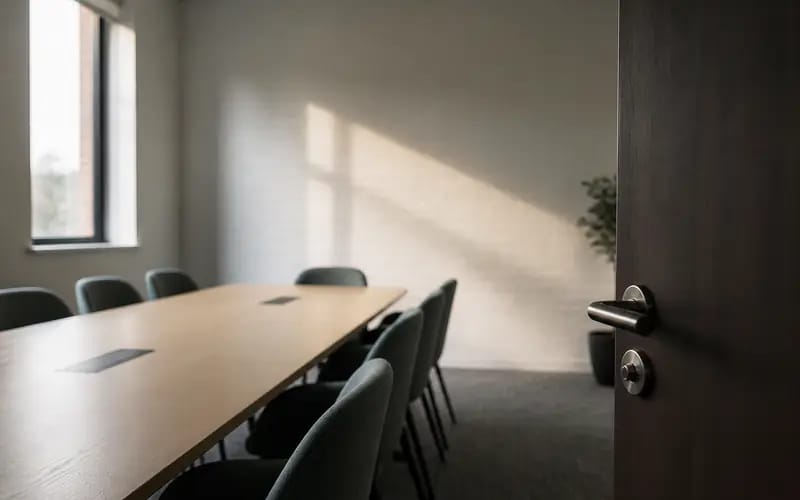
It’s all about sound in meetings! Can you recall those moments in meetings when you struggled to hear speakers from next door? Sound insulation is often overlooked in choosing conference venues, and once you’ve signed on the dotted line, it can be a major issue.
Why Acoustic Privacy Matters
Acoustic privacy is vital for confidential meetings, such as HR discussions, client negotiations and board meetings. Sound will travel through walls and even through ceilings and floors so sensitive conversations need to be held in rooms that are soundproofed. In addition to confidentiality, poor room acoustics can also cause wear and tear on individuals. The sound of background noise or people talking can cause people to strain to hear or to tune out and this can cause tiredness and also affect concentration and the ability to remember what has been said in a meeting.
Check The Wall Construction
First ask whether the walls between conference rooms are made of masonry or are stud partitions which have been finished with plasterboard. Although they look similar solid masonry will block sound far better than a timber stud partition with a cavity. In addition, you should check whether the walls between conference rooms run up to the structural ceiling or if they stop some way short of it. Sound will travel easily through a ceiling void, even if the walls between rooms are soundproofed.
Look At The Doors
Even a good sound-insulating wall can be compromised by a poor door. Check the doors to be used between conference rooms for solid-core construction and good acoustic seals around the frame and threshold. When viewing a room, run your hand along the bottom of the door to check for a drop-down seal or, worse, a visible gap. Even a good sound-insulating wall can suffer from a poor door.
Check The Windows
Glazing is another important factor when considering noise within a room. Windows looking out onto a car park, main road or other busy area with constant vehicle movement can be reduced in noise using double glazing. However, you would need to find out what is outside the windows in the conference room and the typical activities that take place in the outside areas at times when you intend to hold your meetings and events.
Ask About Flooring And Ceilings
Carpeted floors absorb sound much better than hard surfaces, such as wooden or concrete floors, to stop the sounds of footsteps and chair scraping travelling around within a room. Acoustic ceiling tiles also absorb sound to reduce noises such as voices, background music and equipment humming travelling through the air within a room. However, the biggest risk of noise transferring between rooms comes from above, via the shared suspended ceiling void. Is this separated/ compartmentalized within the rooms?
For Cotswolds Hotel Conference Rooms, see Tewkesbury Park.
Think About What’s Next Door
Many conference rooms are situated near the bar, kitchen or a busy corridor. Find out what other rooms and facilities adjoin your proposed conference room and look for these on a plan of the floor. District council planning portals for the local area (e.g. Cotswolds District Council) may contain floor plans of buildings. It is also worth checking these out before visiting the proposed venue.
Test Any Moveable Partitions
Most conference venues have temporary walls between conference and meeting rooms. Even though these rooms can be opened up to make one very large space these walls have to have good sound insulation when they are closed. Ask to see the temporary wall(s) closed and test them by having someone talk in the other room and measure the sound. This will give you an indication of how well the sound has been contained within the room.
Check Equipment Noise
Additional noise may also come from air conditioning units, ceiling mounted projectors, extractor fans etc. Many older properties have retro fitted plant equipment in order to provide services to meeting rooms. It would be wise to ask if the air conditioning can be switched off for quiet parts of your meeting and if there is any noise from the projector fan after it has been running for a short period. For organisations looking for conference room providers in the Cotswolds it would be wise to ask about noise from plant in any brochure specifications in order to determine if a modern looking room is in fact quiet.
Stand In The Room And Listen
The simplest test is to stand in the proposed meeting room with the door shut while another event is going on. You would also want to hear what the other event’s delegates would hear: the sound of a hoover in a corridor, the sound of a door shutting, hearing people in the next suite etc. Most venues hosting business events will agree to a short visit to test the sound in the proposed rooms. It is also worth noting the VAT treatment of room hire for hotels and holiday accommodation, and that this can affect how a price is listed. So it is always worth asking whether a price includes VAT before you compare venues to book for your business meeting or event.
A quiet room for your meetings is important. They may look nice in a brochure but go to the venue and look around and ask some simple questions. I can guarantee you will find out a lot more than reading the brochure.


