
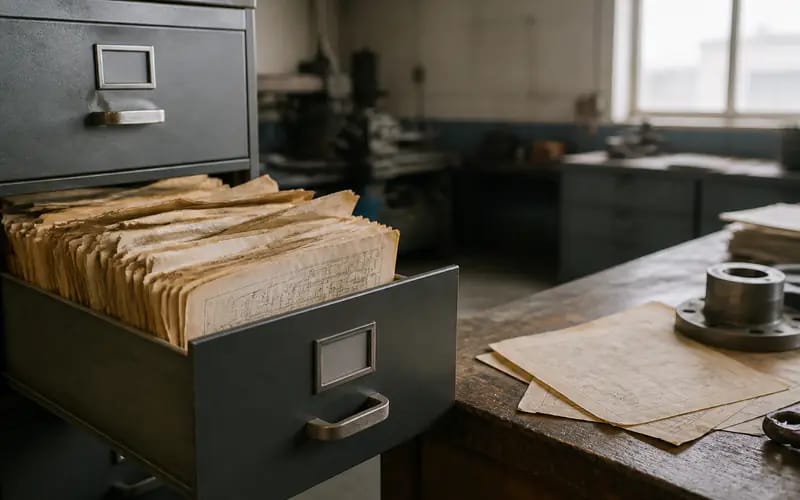
Many manufacturers delay adopting enquiry AI because they believe that they must first tidy their archives for the AI’s benefit. The main barrier to Instro AI’s manufacturing trials has been the customers’ fragmented data built up over decades, not the AI’s ability to deal with it. It’s worth reading Machinery Market’s piece on Instro AI’s manufacturing trials in full.
The main constraint to the manufacturing trials of Instro AI’s Enquiry AI has been found to be the fragmented and poor quality data held within the manufacturers’ archives over decades, not the ability to use the AI tooling itself to start to produce useful answers to enquires.
The tidy-first belief and where it comes from
It makes sense that bad input leads to bad output but a clean-up project is an unusual project in that there is no end-point and it typically lacks an owner until after it has started to gain some momentum and priorities have started to shift. The quality manager is not typically around to ensure that the sorting is completed to a suitable standard.
What decades of data really look like
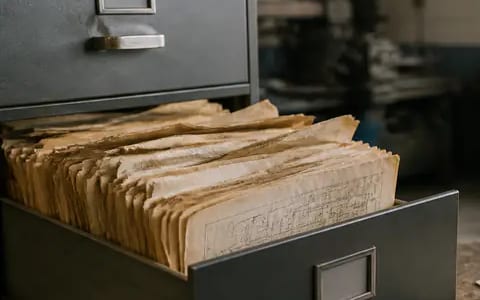
When we talk about ‘decades of data’ we are expecting to find numerous versions of the same process sheet (e.g. drawings) with different revision numbers and possibly with significantly different content. A single process may be referred to by different names on different documents (e.g. drawings, quotes, customer specifications). Additional notes on hard anodising from years ago may use different terms to describe thickness and surface finish.
How conflicting documents surface in daily use
The engineering tool has now drafted real answers, and in the conflict between two sources of information, it is the answer that has been drafted that reveals the discrepancy. The Instro’s engine flags up outdated or conflicting material and, as Pritesh Patel, industrial digitalisation technical lead at AMRC Cymru, commented in the feature, “the real challenge of the data is actually organised knowledge that allows your engineers to go and do something more valuable with their time. And the organising of that knowledge can actually be part of the tool’s function.”
Why flagging beats a clean-up project
Flagging a list of issues to be fixed means that you are making a to-do list in the order of which are most important and therefore need to be fixed first. As long as you are using all the files which are used to give answers to enquiries then the rest of the data can be left as it is – dusty in the corner of a filing cabinet.
Start with the use case and let the data follow
The trials that Poeton Industries have been carrying out with Instro AI’s manufacturing enquiries AI have been set up in a sequence of stages with the first stage focused on delivering faster and more consistent technical responses. Here the searches have been focused on returning the most relevant knowledge from within the organisation and then to use this knowledge to automatically draft responses that can be reviewed by staff. I would start with one enquiry stream and get the tool to work on it and then work through all the flags that it has identified.


