
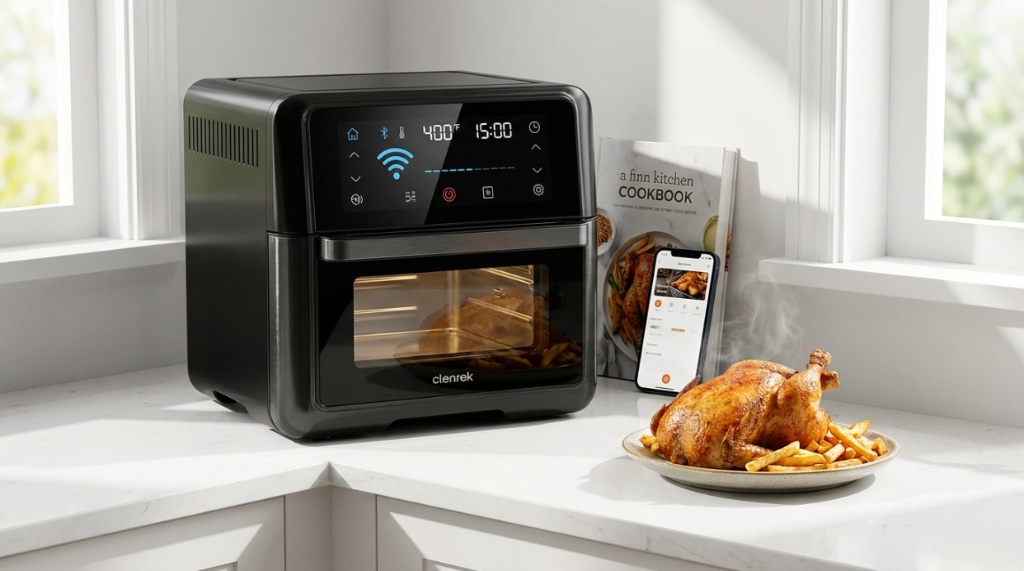
Comparing smart air fryer ovens by reading product pages is like comparing cars by reading bumper stickers — every brand highlights different strengths while hiding identical weaknesses behind creative marketing language. Knowing how to compare air fryer oven reviews and specifications objectively requires a standardized framework that cuts through marketing and evaluates what genuinely determines daily cooking satisfaction. A smart air fryer oven comparison involves evaluating cooking performance (temperature accuracy, evenness, speed), smart capability (app quality, automation depth, update frequency), build quality (materials, insulation, longevity), and practical usability (cleaning ease, noise level, counter footprint) across competing models. The challenge? Every brand emphasizes different metrics. One highlights 15 cooking functions. Another promotes 1800W power. A third leads with its AI camera. Without a consistent comparison framework, you’re comparing apples to oranges to algorithms. This air fryer oven comparison guide provides the exact evaluation system that standardizes your assessment — ensuring you compare what matters rather than what brands want you to focus on.
What Comparison Framework Should You Use?
Use a five-category weighted comparison: Cooking Performance (35% weight), Smart Features (25%), Build Quality (20%), Usability (15%), and Value (5%) — this reflects the actual priority order that determines long-term satisfaction with a kitchen appliance.
The comparison framework:
| Category (Weight) | What to Evaluate | How to Score |
|---|---|---|
| Cooking Performance (35%) | Temperature accuracy, even heating, preheat speed, air frying crispiness, versatility | User reviews + professional test results |
| Smart Features (25%) | App quality, automation depth, probe capability, recipe integration, update history | App store ratings + hands-on reviews |
| Build Quality (20%) | Materials, insulation, component durability, warranty length | Expert teardowns + 12-month owner reviews |
| Usability (15%) | Cleaning ease, noise level, door mechanism, control intuitiveness, size/footprint | Owner reviews focusing on daily use frustrations |
| Value (5%) | Price relative to features delivered, cost-per-year, included accessories | Feature-to-price ratio calculation |
Why cooking performance weighs heaviest: a smart oven with perfect app connectivity that cooks food unevenly is a failure. A basic oven that cooks food perfectly every time without an app is still a success. Smart features enhance great cooking — they can’t fix bad cooking. Always prioritize the fundamental cooking quality first.
How Do You Compare Cooking Performance Objectively?
Compare cooking performance by checking three specific data points: temperature accuracy (does it hold the stated temperature within ±5°F), heat distribution evenness (do user reviews mention hot spots or uneven browning), and air-frying result quality (crispiness comparable to deep frying).
Performance comparison method:
- Temperature accuracy test data: Professional review sites (Wirecutter, Serious Eats, Consumer Reports) test actual vs. stated temperatures using calibrated thermometers. An oven set to 400°F that actually runs at 380°F or 420°F produces inconsistent results with any recipe. Accept a ±5°F variance as good, ±10°F as concerning, and beyond ±15°F as disqualifying.
- Even heating assessment: Search user reviews for keywords: “uneven,” “hot spots,” “rotate,” “one side burned.” If multiple reviewers mention needing to rotate food mid-cook, the oven has heat distribution problems that force manual intervention—defeating smart automation benefits.
- Air frying crispiness: The core promise. Check review photos showing actual results: golden, crispy French fries; evenly browned chicken wings; and crisp-skinned fish. If reviews consistently show pale, soft results despite following instructions, the convection system underperforms regardless of other features.
- Cooking speed consistency: Verify that preset cooking times align with actual completion. If the oven consistently needs 5+ extra minutes beyond its own preset estimates, the programming is poorly calibrated to the hardware’s actual performance.
Comparison shortcut: focus on “6-month” and “1-year” reviews rather than first-week impressions. Long-term owners report actual cooking performance patterns that initial-excitement reviews miss.
How Do You Evaluate Smart Feature Quality Across Brands?
Evaluate smart feature quality by testing the companion app before purchasing (download free), checking app store update frequency (monthly = active support), reading app reviews separately from oven reviews, and verifying which smart features work offline versus requiring constant internet.
Smart feature evaluation process:
- Download the app first: Every major smart oven brand has a free companion app. Download it before buying and explore the interface, recipe library, and feature depth. A clunky, unintuitive app will frustrate you daily regardless of how good the oven hardware performs.
- Check app store ratings independently: An oven with 4.5 stars on Amazon but a 2.8-star app on the Play Store indicates a hardware-software disconnect. The app IS the smart experience—poor app quality negates hardware investment.
- Update frequency verification: Check “last updated” date in the app store. Updated within 30 days = actively supported. Updated 6+ months ago = potentially abandoned. Dead apps mean your “smart” oven eventually becomes a basic oven with a useless WiFi chip.
- Offline capability assessment: Which features work without internet? Quality smart ovens operate all cooking functions independently from WiFi — the app adds convenience but isn’t required. Ovens that can’t run presets without WiFi connection have a critical dependency that creates failure points.
- Feature depth vs. breadth: Compare how deeply each brand implements its key features. Does the recipe library have 50 recipes or 500? Are presets one-touch (food type + weight) or multi-step, requiring manual input? Depth indicates engineering investment; breadth alone often indicates feature padding.
What Build Quality Indicators Separate Premium From Budget?
Premium build quality shows through: a stainless steel interior (not painted metal), double-wall insulation (cool exterior), solid door hinges (no wobble after 6 months), quality heating elements (branded nichrome wire), and sealed control panels that resist grease infiltration.
Build quality comparison points:
- Interior material: Stainless steel interiors resist staining, don’t chip or flake, and maintain hygiene long-term. Painted/coated interiors can chip (contaminating food), develop permanent stains, and peel within 1–2 years of daily use. Non-stick coating is acceptable in quality; verify in reviews whether coating durability holds up.
- Insulation testing (read reviews): Search for “hot outside,” “exterior temperature,” or “burns” in user reviews. Well-insulated ovens keep exteriors below 100°F during operation. Poorly insulated models create burn risks, waste energy, and heat your kitchen unnecessarily.
- Door mechanism quality: Open and close the door 10 times (in-store if possible). Premium: smooth, even resistance, no wobble, secure seal. Budget: loose fit, wobble after months, and seal gaps that leak heat. The door is the most mechanically stressed component — it reveals build quality immediately.
- Control panel durability: Are controls sealed against grease splash? Kitchen environments deposit oil and moisture on every surface. Unsealed touch panels or buttons with gaps allow grease infiltration that causes malfunction within months. Sealed, wipe-clean control surfaces indicate longevity-aware design.
- Weight (counterintuitive indicator): Heavier ovens generally indicate thicker materials, better insulation, and more substantial construction. Ultra-light models (under 15 lbs for a 25-quart oven) may indicate thin single-wall construction, minimal insulation, and lightweight components that won’t endure years of thermal cycling.
How Do Current Top Models Compare Head-to-Head?
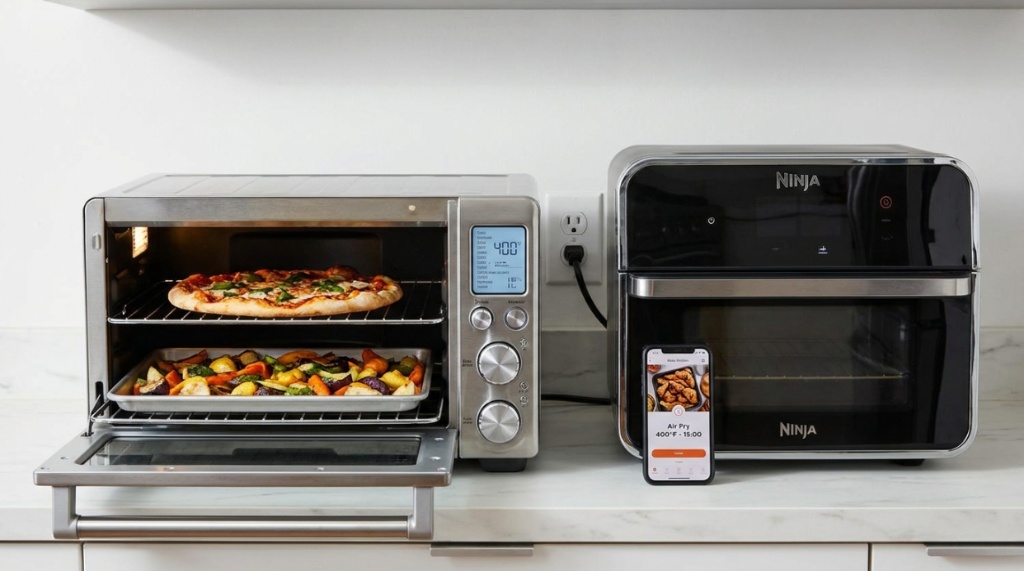
The current top smart air fryer ovens—Breville Joule Oven Air, Ninja Foodi Smart XL, Cosori Smart 30L, and June Oven—each lead in different categories, with no single model dominating all five comparison areas simultaneously.
Head-to-head comparison:
| Model | Cooking (35%) | Smart (25%) | Build (20%) | Usability (15%) | Value (5%) | Overall |
|---|---|---|---|---|---|---|
| Breville Joule Oven Air | ★★★★★ | ★★★★☆ | ★★★★★ | ★★★★☆ | ★★★☆☆ | Best cooking + build |
| Ninja Foodi Smart XL | ★★★★☆ | ★★★★☆ | ★★★★☆ | ★★★★★ | ★★★★☆ | Best versatility + usability |
| Cosori Smart 30L | ★★★★☆ | ★★★★☆ | ★★★☆☆ | ★★★★☆ | ★★★★★ | Best value |
| June Oven (3rd gen) | ★★★★☆ | ★★★★★ | ★★★★☆ | ★★★☆☆ | ★★☆☆☆ | Best smart tech |
Recommendation by priority:
- If cooking precision matters most: Breville Joule Oven Air — Element IQ delivers the most accurate, even cooking results in testing.
- If versatility and family friendliness matter most: Ninja Foodi Smart XL — most cooking functions, easiest interface, includes a probe.
- If budget matters most: Cosori Smart 30L—85% of premium features at 50% of premium price.
- If cutting-edge smart technology matters most: June Oven — AI camera, food recognition, and most automated cooking intelligence available.

Where Should You Read Reliable Reviews?
Read reviews from hands-on testing publications (Wirecutter, Serious Eats, America’s Test Kitchen); long-term owner reviews (Amazon filtered to 6+ month ownership); YouTube teardowns that show internal construction; and Reddit communities (r/airfryer, r/cooking) where owners share unfiltered experiences.
Review source reliability hierarchy:
- Tier 1 (Most reliable): Professional testing publications that buy units independently, test with instruments, and compare against multiple models in controlled conditions. Wirecutter, Serious Eats, Consumer Reports, America’s Test Kitchen.
- Tier 2 (Valuable): Long-term owner reviews (3+ months) on Amazon/retail sites. Filter by “verified purchase” and sort by most recent to capture current model performance. Look for detailed reviews mentioning specific cooking results over time.
- Tier 3 (Supplementary): YouTube reviews with actual cooking demonstrations (not just unboxing). Channels that cook multiple meals and show results over weeks provide real-world validation that spec comparisons cannot.
- Tier 4 (Use cautiously): Blog reviews that received free units from brands. These often skew positive due to relationship dynamics. Useful for feature demonstrations but unreliable for honest criticism.
Red flag in reviews: if a model has overwhelmingly positive professional reviews but significant negative owner reviews after 3–6 months, trust the long-term owners. Professional reviewers test for days; owners live with the product for years. Their experience is more predictive of your experience.
While upgrading your indoor kitchen setup with smart appliances offers incredible convenience, don’t overlook your outdoor cooking layout if you love hosting weekend cookouts. If you want to expand your culinary toolkit on a budget, you can easily pick cheap BBQ grills without compromising quality by focusing on heavy-duty grates and reliable heat retention over pricey brand names. Balancing a smart countertop oven indoors with a high-value grill outside gives you the ultimate year-round cooking versatility.
Conclusion
Comparing smart air fryer ovens effectively requires structured evaluation across cooking performance, smart features, build quality, usability, and value—weighted by their actual impact on daily satisfaction. Cooking performance must lead your decision because no amount of smart technology compensates for uneven heating or inadequate air-frying capability. Smart features rank second because they define whether the premium you’re paying over a basic oven actually delivers daily convenience returns.
Use the five-category framework, download companion apps before purchasing, read 6-month owner reviews for real-world performance data, and prioritize the category that matters most to your specific cooking life. The best smart air fryer oven for you isn’t the one that wins every category — it’s the one that wins the categories you care about most while remaining adequate in the others.
Frequently Asked Questions
What’s the most important spec to compare between air fryer ovens?
Wattage-to-capacity ratio (watts divided by quart capacity). This determines whether the oven can maintain proper air frying temperatures when loaded with food. Under 60 watts per quart risks underpowered performance. 65–80 watts per quart indicates adequate power for the cooking space. This single metric predicts air-frying quality more reliably than any other specification.
Should I trust Amazon star ratings when comparing models?
Use star ratings as initial filters (avoid anything below 4.0 stars with 500+ reviews) but never as final decision criteria. Read the actual text of 3-star reviews—these are typically the most honest, balanced assessments. 5-star reviews often reflect first-week excitement. 1-star reviews often reflect shipping damage or user error. The middle ground reveals actual product quality.
How do I compare ovens I can’t test in person?
Rely on: video reviews showing actual cooking results, detailed owner reviews with photos, professional test data from publications, and the companion app experience (downloadable for free). Combined, these sources provide more information than a brief in-store demonstration where you can’t actually cook food or test smart features meaningfully.
Is it worth waiting for newer models or buying current ones?
Current-generation smart air fryer ovens (2024–2025 models) have reached mature performance levels. Waiting gains incremental improvements rather than revolutionary changes. If you need the appliance now, buy now — the technology is proven. If a specific brand announces a major refresh within 60 days, waiting might save money on the outgoing model (clearance pricing) rather than gaining meaningful new features.
How many models should I seriously compare before deciding?
Compare 3–4 models maximum in your price range. More than 4 creates decision paralysis without meaningful additional insight. Start with 8–10 options, eliminate by price/size/obvious deal-breakers, then deeply compare your final 3–4 using the weighted framework. This focused comparison delivers confident decisions faster than broad surface-level browsing across dozens of models.
Do professional review rankings match real owner satisfaction?
Usually — with one caveat. Professional reviews test cooking performance excellently but underweight long-term reliability, app stability, and daily cleaning frustrations that only emerge after months of use. A professionally top-ranked oven that’s difficult to clean daily loses points in real-world owner satisfaction that short testing periods don’t reveal. Weight both perspectives accordingly.


