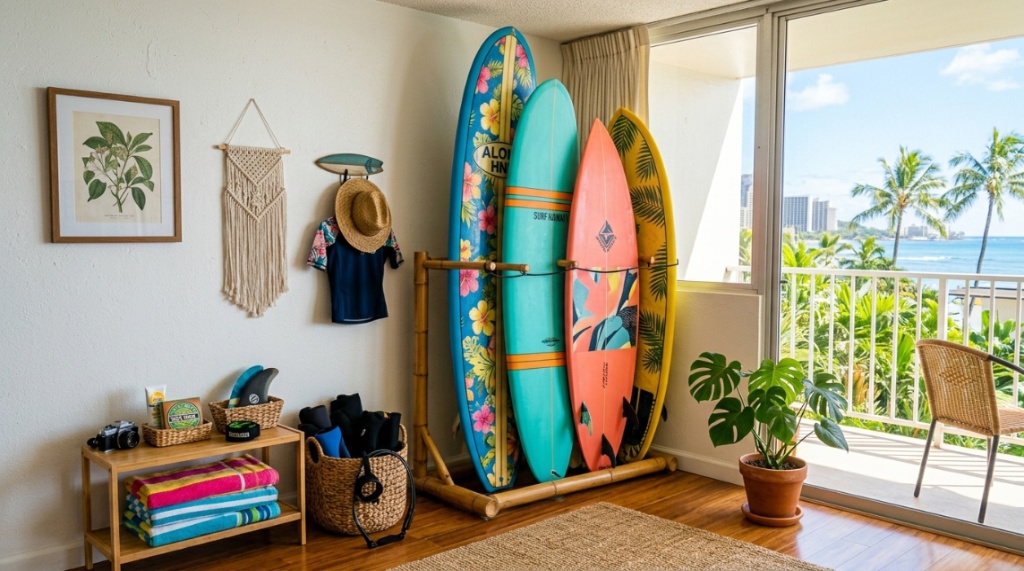
You just finished an epic session at Ala Moana Bowls. Your quiver is salty, sand is grinding into your wax, and your prized shaped-right-here board is dripping all over your lanai. Sound familiar? In Hawaii, where square footage is premium and humidity is a constant battle, storing a quiver flat on the ground invites warping, fin damage, and rusty stringers. The solution is simpler than you think: vertical surfboard storage Hawaii is not just a space-saver—it is a board-life extender. By shifting your storage from horizontal to vertical, you protect your investment, free up living space, and keep your boards ready for the next swell.
Why Is Vertical Storage Better for Surfboards in Hawaii?
Vertical storage keeps boards upright, reducing pressure points and allowing airflow to combat Hawaii’s corrosive salt air. It prevents warping, saves precious floor space, and makes grabbing a board for a dawn patrol session much faster.
Prevents Board Warping and Delamination
Laying a surfboard flat for weeks in a humid Hawaiian garage creates hot spots and moisture traps. When stored vertically, the weight of the board is distributed evenly along the stringer. This eliminates the dreaded “camber” curve that happens when a heavy board rests on a single point for too long.
Maximizes Limited Square Footage
Whether you live in a Waikiki studio or a Kailua townhouse, floor space is gold. A vertical rack holds 4 to 8 boards in the same footprint as a single horizontal stack. You reclaim your garage for a car or your lanai for a beer after the session.
Protects Fins from Accidental Snaps
Fins are the most vulnerable part of a board. In horizontal piles, fins get knocked, stepped on, or bent. Vertical storage keeps fins hanging free or resting gently against foam padding, drastically reducing the risk of costly fiberglass repairs.
What Is the Best Type of Vertical Surfboard Rack for Hawaii Homes?
The best rack is a freestanding, padded steel or heavy-duty PVC unit that resists rust and holds boards by the rail (not the nose or tail). Look for marine-grade materials to withstand humidity.
Freestanding vs. Wall-Mounted Racks
Wall-mounted racks are ideal if you own your home and have solid studs. They keep boards off the floor entirely. Freestanding racks are better for renters or those who move their setup around. Both work for vertical surfboard storage Hawaii, but freestanding units offer more flexibility in condo complexes.
Material Matters: Rust Resistance is Key
In Hawaii, standard steel racks rust within months. Always choose racks with powder-coated steel, anodized aluminum, or heavy-duty UV-stabilized plastic. Avoid raw wood, which can rot and introduce termites into your board bag.
Padding Density and Rail Protection
Your board’s rail (the edge) bears the weight in vertical storage. Look for racks with thick, closed-cell foam sleeves. Cheap open-cell foam absorbs moisture and salt, leading to rail rot. High-density EVA foam or neoprene sleeves are the gold standard,Before mounting your vertical rack, make sure your hardware is secure and ready for tropical conditions by taking the time to pick the best surfboard fin screws for any wave condition.
How Do You Properly Store a Surfboard Vertically in Hawaii?
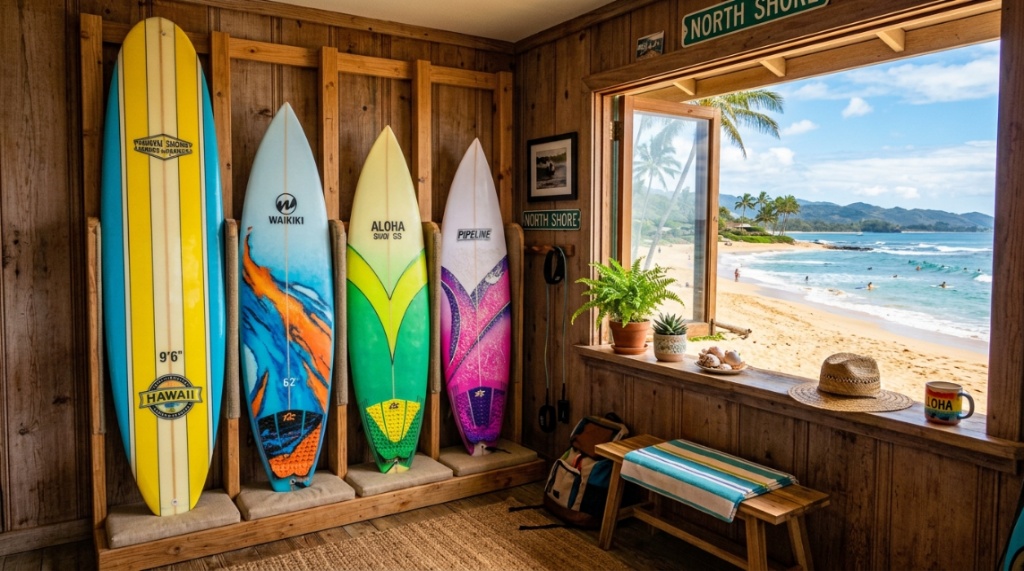
Position the board with the stringer aligned perfectly upright, fins facing away from walls, and the tail resting on a padded base. Never force a board into a slot that is too tight.
Step-by-Step Vertical Storage Process
- Rinse and dry: Always rinse your board with fresh water after a session. Use a soft cloth to dry the leash plug and fin boxes. Salt crystals left on the board will crystallize and scratch the glass.
- Check the tail: Ensure the tail pad is clean. Dirt and sand will grind into the rack’s padding.
- Slide in rail-first: Gently insert the board with the stringer facing straight up. Do not twist or torque the board.
- Position the fins: If the rack has fin slots, use them. If not, ensure fins face the open room, not a wall.
- Leave space for airflow: Do not cram boards side-by-side. A 1–2 inch gap between each board allows air to circulate and prevents mold.
Common Mistakes to Avoid
- Storing wet boards: A wet board in a vertical rack creates a waterline stain and promotes delamination.
- Overcrowding: Forcing too many boards into one rack puts lateral pressure on the stringers.
- Direct sunlight: Even in a vertical rack, keep boards away from direct sun. UV rays weaken the resin, especially at higher altitudes on Oahu or Maui.
Can You Store Longboards and Shortboards Together Vertically?
Yes, but you need adjustable rack arms or separate tiered levels. Longboards require wider spacing and lower slots to avoid tipping, while shortboards fit comfortably in higher, narrower slots.
Tiered Rack Configurations
Look for racks with adjustable crossbars. A 9’6″ longboard needs about 6 inches of depth to balance properly, while a 5’8″ fish only needs 4 inches. Many quality freestanding racks allow you to move the padded arms up or down to accommodate mixed quivers.
Weight Distribution Concerns
Longboards are heavier. Place them on lower tiers to keep the rack’s center of gravity low. Shortboards can go on top. This prevents the entire rack from becoming top-heavy and tipping over, which is a real risk in earthquake-prone or high-wind areas like the Big Island.
Which Vertical Storage Materials Last Longest in Hawaii’s Climate?
Marine-grade stainless steel (316 grade) and UV-stabilized polyethylene are the longest-lasting materials. Avoid chrome-plated steel and untreated pine.
Comparison of Common Rack Materials
| Material | Hawaii Lifespan | Best Use |
|---|---|---|
| Powder-coated steel | 3–5 years | Covered garages, lanais |
| Stainless steel (316) | 10+ years | Outdoor, uncovered areas |
| Heavy-duty PVC | 2–4 years | Indoor, climate-controlled |
| Anodized aluminum | 5–7 years | Best overall balance of weight and rust resistance |
Why Marine-Grade Matters
Hawaii’s salt air is relentless. Standard steel racks will begin to rust and flake within 6 months if placed outdoors. Flaking rust contaminates your board’s foam and resin. Spending a little extra on a marine-grade rack saves you from buying a new rack every year and potentially ruining a $700 board.
How Many Boards Fit in a Standard Vertical Storage Rack?
A standard 4-tier wall rack holds 4 to 6 boards. A freestanding double-sided rack holds 8 to 12 boards, depending on width and board thickness.
Calculating the Right Capacity for Your Quiver
Count every board you own, including the beater board you use for shore breaks. Then add one extra slot for the next board you know you will buy. Overcrowding is the #1 cause of aesthetic dings in vertical storage.
Space Optimization Tips for Small Units
- Use ceiling-mounted hooks for a shortboard if you have high ceilings.
- Combine vertical racks with a shelf above for wax, leashes, and fins.
- If you own a vertical surfboard storage Hawaii system with modular arms, you can reconfigure it as your quiver changes.
Is Vertical Storage Safe for EPS and Epoxy Boards?
Yes, but EPS (expanded polystyrene) boards are more prone to dents and compression. You must use extra padding on the rails and ensure the rack does not pinch the board too tightly.
Special Considerations for Foam Core Boards
EPS boards are lighter and more buoyant, but their foam cores are softer. If the rack’s foam padding is too hard, it will create indentations over time. Use racks with at least 1/2 inch of soft neoprene or thick EVA foam on the contact points.
Temperature and EPS Stability
In the Hawaiian sun, an EPS board stored vertically in an unventilated garage can reach internal temperatures that soften the epoxy resin. Always store EPS boards in a shaded, ventilated area, even inside a vertical rack.
How Do You Install a Wall-Mounted Vertical Rack in a Hawaiian Garage?
Locate wooden studs using a stud finder, drill pilot holes, and use stainless steel lag bolts (not drywall anchors). The rack must bear the weight of several boards without pulling out of the wall.
Finding Studs in Concrete Block Walls
Many Hawaiian garages have concrete block walls. You cannot simply screw into the block. Use concrete anchors (Tapcon screws) or a heavy-duty adhesive system rated for 100+ pounds per bracket. If in doubt, consult a local handyman familiar with surfboard storage Hawaii setups.
Leaving an Air Gap for Ventilation
Mount the rack at least 4 inches away from the wall. This allows air to flow behind the boards and prevents moisture buildup from concrete sweating, which is common in humid island climates.
What Are the Hidden Costs of Poor Surfboard Storage in Hawaii?
Rotten foam, snapped fins, delaminated glass, and premature yellowing of the resin can cost you $200–$800 in repairs per board per year. Proper vertical storage eliminates these expenses.
Repair Cost Comparison
- Rail dent from poor rack padding: $40–$100 repair
- Warped stringer from flat storage: Often unrepairable, board replacement $500–$900
- Broken fin from horizontal stacking: $20–$80 per fin
- Mold and mildew removal: $50–$150 for deep cleaning
Investment vs. Savings
A quality vertical rack costs between $80 and $250. In the first year, it will likely save you at least one major repair. Over five years, a rack pays for itself multiple times over while keeping your quiver ready for action at a moment’s notice.
Frequently Asked Questions
Should fins be facing up or down in vertical storage?
Fins should face away from the wall and away from other boards. This prevents fins from scratching neighboring boards and reduces the chance of snapping a fin when pulling a board out of the rack.
Can I store a surfboard vertically with a leash attached?
It is best to remove the leash. A wrapped leash can trap moisture against the board. If you must leave it on, loosely coil the leash and secure it with a velcro strap, keeping it away from the fin boxes.
How often should I rotate boards in vertical storage?
Rotate your boards every 3–4 months if you have not ridden them. This changes the pressure points on the rails and helps the foam memory retain its original shape.
Is vertical storage safe for antique or vintage surfboards?
Antique boards with brittle resin and older foam should be stored vertically only if the rack has extremely soft, wide padding. For fragile vintage logs, horizontal storage on a padded rack with full-length support is often safer.
Can I use a vertical rack outdoors in Hawaii?
Yes, but only with a weatherproof cover or by placing the rack under a covered lanai. Direct UV exposure and rain will degrade both the rack and the boards. Use a UV-protective board bag if storing outdoors.
What is the ideal temperature for surfboard storage?
Keep boards between 60°F and 85°F. Avoid attics or uninsulated sheds where temperatures can exceed 100°F, which causes resin to soften and foam to expand.
Do I need a special rack for foam surfboards (soft tops)?
Soft tops are bulkier and heavier. Use a rack with wider padded arms (at least 3 inches wide) to prevent the foam from deforming. Standard narrow racks can leave deep grooves in soft-top foam.