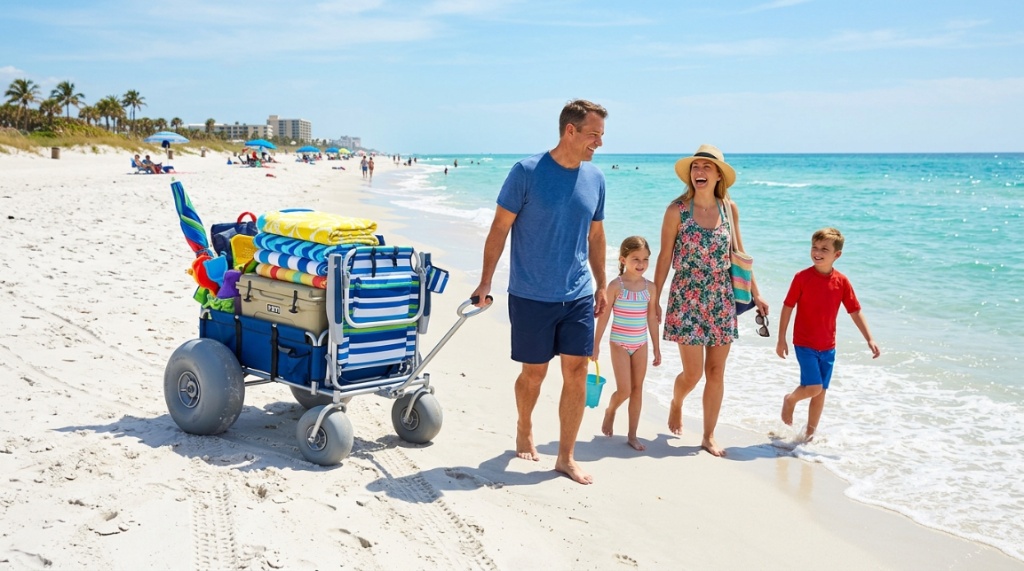
You’ve finally made it to the beach. The sun is out, the water is warm, and you’re ready to relax. But then comes the reality of hauling your cooler, chairs, umbrella, and beach bag across a wide stretch of powdery, soft Florida sand. A standard wagon with plastic wheels sinks immediately, leaving you stuck and frustrated before you’ve even set up your spot. The solution is a specialized beach cart for soft florida sand, but not all carts are created equal. This guide breaks down exactly what to look for, how to avoid common mistakes, and how to choose a cart that will glide over the sand rather than dig into it.
Why Standard Wagons Fail on Florida Beaches
Florida’s Gulf Coast and Atlantic beaches are famous for their sugar-white, powdery sand. While beautiful, this sand is notoriously difficult to traverse. Standard utility wagons are designed for pavement, grass, or gravel, and they fail on soft sand for two primary reasons: wheel size and tire type.
Most standard wagons come with hard plastic wheels that are roughly 8 inches in diameter. These wheels have a small surface area, which means they exert a high amount of pressure per square inch. When you place that pressure on soft sand, the wheels sink. Once the wheel is buried, the axle is dragging, and you are essentially pushing a plow. Additionally, hard plastic has zero flexibility, so it cannot conform to the uneven surface of the sand to gain traction.
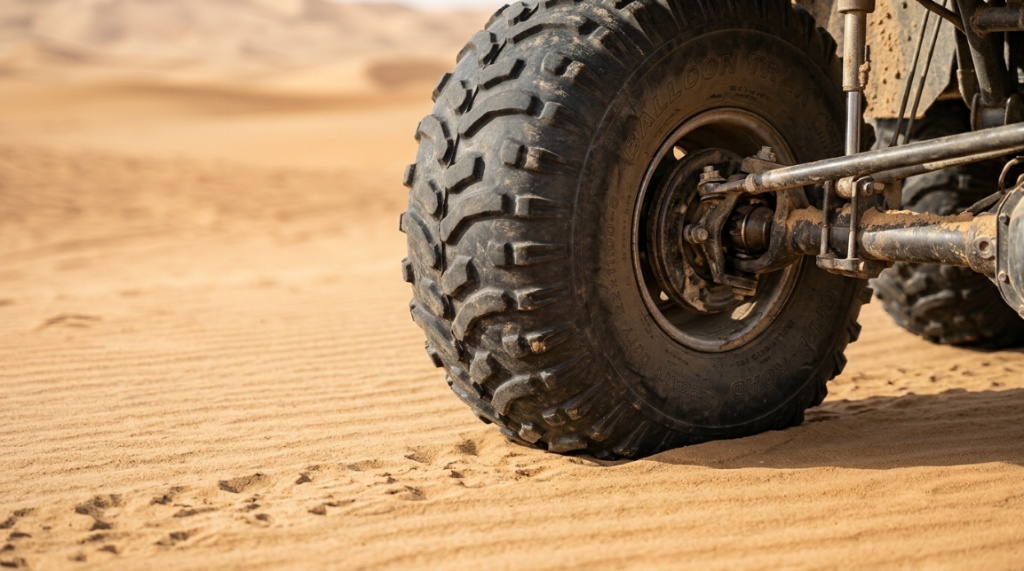
To successfully navigate soft sand, you need a cart specifically engineered with balloon tires. These are wide, low-pressure tires that “float” on top of the sand rather than cutting through it. Think of the difference between walking in snow with dress shoes versus snowshoes; the principle is exactly the same.
Key Features to Look for in a Sand Cart
When you start shopping for a beach cart for soft florida sand, you will notice a wide range of prices and designs. To cut through the noise, focus on these non-negotiable features that directly impact performance and longevity.
Wheel Size and Tire Type
This is the most critical decision. Look for wheels that are at least 10 inches in diameter, though 12 inches or larger is even better for deep, dry sand. The tires must be inflatable (air-filled) or made of a soft, foam-filled rubber that mimics pneumatic tires. Inflatable tires offer the best ride because you can adjust the pressure; slightly deflating them increases the surface area and provides more floatation. Avoid solid plastic wheels entirely, regardless of their size.
Frame Material and Rust Resistance
Florida’s beach environment is brutal on equipment. Saltwater, salt air, and humidity will corrode cheap steel within a season. Look for carts with frames made from aluminum or stainless steel. Aluminum is lightweight and naturally resistant to corrosion, making it the preferred choice for most beachgoers. If a cart uses steel, ensure it has a heavy-duty powder-coated finish, but be aware that scratches will eventually expose the metal to rust.
Weight and Foldability
You will likely have to lift the cart in and out of your car trunk. A heavy cart defeats the purpose of saving your energy. Look for a cart that weighs between 20 and 30 pounds. While heavier carts often have more features, you need to balance that with your physical ability to lift it. Foldability is also essential for storage. Most quality carts fold flat, but check the folded dimensions to ensure they fit in your vehicle. Some carts fold into a compact rectangle, while others fold in half, which can be easier to manage.
Understanding Cart Capacity and Size
Before purchasing, consider exactly what you plan to carry. Are you a solo sunbather with a small chair and a backpack? Or are you hauling gear for a family of four, including a canopy tent and a large cooler?
Capacity is usually listed in pounds, but the physical dimensions of the cargo area matter just as much. A cart might hold 150 pounds, but if the basket is too short, your cooler will stick out and shift the center of gravity. Look for a cart with a deep, wide basket. Also, pay attention to the handle design. A “U” shaped handle or a pull handle that extends high enough allows for comfortable towing without bending over. Some carts feature a handle that converts from a pull position to a push position, which can be helpful when navigating tight spaces or ramps.
Consider the wheelbase width as well. A wider wheelbase provides more stability, preventing the cart from tipping over when you place a heavy cooler on one side. However, a very wide cart might be difficult to maneuver through narrow beach access paths or crowded areas.
Comparing Cart Styles: Which Is Right for You?
Not all beach carts are built the same. There are three main styles you will encounter, and each has distinct advantages and trade-offs.
| Feature | Folding Wagon | Collapsible Beach Cart | Heavy-Duty Utility Cart |
|---|---|---|---|
| Best For | Families with kids and gear | Couples or small groups | Serious anglers or large setups |
| Wheels | Often 10-12 inch inflatable | Usually 10-12 inch inflatable | Large, 16+ inch inflatable |
| Weight | Heavier (30-40 lbs) | Lightweight (15-25 lbs) | Heaviest (40+ lbs) |
| Maneuverability | Good, but can be bulky | Excellent, easy to steer | Excellent on deep sand, poor in crowds |
| Storage | Folds flat, but large footprint | Folds compactly | Rarely folds small |
Folding Wagons
These are the most popular choice for families. They feature a boxy shape with a rigid frame and usually have a pull handle. The best models for sand have a “beach package” that includes wide balloon wheels. They are excellent for carrying large, bulky items like coolers and tents. The downside is that they are heavier and take up more trunk space than other styles.
Collapsible Beach Carts
These are typically lighter and feature a simpler frame with a fabric sling or mesh basket. They often have a single pull handle and are designed to be pushed or pulled like a wheelbarrow. They are easier to lift and store, making them ideal for individuals or couples. However, they may not have the structural rigidity to support extremely heavy loads without sagging, Planning your special day along the coast? Discover inspiration and ideas on Find Stylish Candles for Florida Weddings.
Heavy-Duty Utility Carts
These are the workhorses of the beach. They feature massive wheels, often 16 inches or larger, and are built to carry fishing rods, large coolers, and even small kayaks. They excel in the softest, deepest sand. However, they are expensive, heavy, and often too large for casual use or small vehicles.
Common Mistakes to Avoid When Buying
Even with the right information, it is easy to make a costly error. Here are the most common mistakes people make when selecting a beach cart.
- Ignoring the “Beach” Label: Just because a cart is sold at a beach store doesn’t mean it is suitable for soft sand. Always check the wheel diameter and type. If the wheels are less than 10 inches and hard plastic, it is a “boardwalk” cart, not a “sand” cart.
- Choosing a Cart with a Low Clearance: The distance between the axle and the ground is crucial. If the cart sits too low, the bottom of the basket will drag in the sand when you hit a soft patch. Look for a cart with a high axle clearance to prevent this “bottoming out” effect.
- Prioritizing Price Over Durability: The cheapest carts on the market often use thin steel frames that bend under load and rust quickly. While you don’t need the most expensive model, avoid the bottom-tier options. A mid-range cart with an aluminum frame will last significantly longer and perform better.
- Forgetting About the Terrain: If you are going to a beach with a long, steep ramp from the parking lot to the sand, you need a cart with good brakes or a handle that allows you to control the descent. Some carts have a handbrake on the handle, which is a valuable safety feature.
Maintenance Tips for Longevity
Once you have the right cart, a little maintenance will ensure it lasts for many seasons. The biggest enemy is salt corrosion. After every beach trip, rinse the cart thoroughly with fresh water. Pay special attention to the wheels, axles, and any metal joints. If you don’t have access to a hose, keep a large spray bottle of fresh water in your car to rinse off the worst of the salt and sand immediately.
Dry the cart completely before folding and storing it. If you have inflatable tires, check the air pressure before each trip. Soft tires can cause the wheel rims to bend. Lubricate the wheel bearings and folding joints with a silicone-based lubricant (not WD-40, which washes away quickly) every few months to keep the wheels spinning freely and the folding mechanism operating smoothly,
Frequently Asked Questions
Can I use a regular garden wagon on the beach?
No. Regular garden wagons have small, hard plastic wheels that will sink into soft sand immediately. They are designed for hard, flat surfaces. You need a cart with large, wide, inflatable balloon tires to float over the sand.
Are inflatable tires better than foam-filled tires for sand?
Inflatable tires generally provide a smoother ride because you can adjust the air pressure. Slightly deflating them increases the tire’s footprint, offering better floatation on soft sand. Foam-filled tires are maintenance-free and never go flat, but they are heavier and provide a stiffer ride.
How much weight should my beach cart hold?
Consider the heaviest load you will realistically carry. For a family of four with a large cooler, tent, and chairs, look for a cart rated for at least 150 pounds. For couples or individuals, a 100-pound capacity is usually sufficient. Always leave a safety margin; a cart rated for 150 pounds will perform better with 120 pounds on it than one rated for exactly 120 pounds.
What is the best way to clean a beach cart after use?
Rinse the entire cart with fresh water immediately after leaving the beach to remove salt and sand. Use a mild soap if there is visible grime. Dry it thoroughly with a towel or let it air dry in the sun before folding to prevent mold and rust.
Are two-wheeled carts better than four-wheeled carts?
Four-wheeled carts are more stable and can carry more weight, making them better for families and large loads. Two-wheeled carts are lighter and more maneuverable, but they require more effort to balance and are better suited for light loads like a single chair and a small cooler.
Conclusion
Selecting the right beach cart for soft Florida sand comes down to understanding the environment and the physics of flotation. You need a cart with large, inflatable balloon tires, a rust-resistant frame, and a size that fits your gear and your vehicle. Avoid the temptation to buy a cheap utility wagon, as it will only lead to frustration. By focusing on wheel size, frame material, and capacity, you can find a cart that makes your trip to the beach effortless. Invest in a quality cart, take care of it with fresh-water rinses, and you will be able to enjoy a stress-free day by the ocean for years to come.