
You finally decided to buy a paddleboard, but the price tags are all over the place. Some boards cost more than a used car, while others seem suspiciously cheap. The problem is real: how do you know which affordable option will actually hold up on the water without sinking your budget? Whether you are looking for affordable stand-up paddleboards for Washington lakes or coastal waters, the key is knowing exactly what to compare before you click “buy.” This guide breaks down every comparison point so you can make a smart purchase with confidence.
What Makes a Paddleboard Truly Affordable Without Being Cheap?
Defining “affordable” in the paddleboard market
Affordable does not mean low quality. In the paddleboard world, an affordable board typically falls between $300 and $700. Boards under $200 often lack durability, while boards over $800 cross into premium territory. The sweet spot gives you reliable construction, good stability, and decent accessories without the boutique brand markup.
Material quality vs. price trade-offs
Cheaper boards use single-layer PVC or basic drop-stitch material that may flex under heavier paddlers. Affordable boards often use double-layer PVC or reinforced drop-stitch, which adds weight but improves rigidity. Compare the material layers directly in the product specs—two layers almost always beat one layer for long-term value.
What you should never sacrifice for a lower price
Never compromise on the air valve quality, the glued seams on inflatable boards, or the fin system. A broken valve ruins your day on the water. Cheap fin boxes can strip out after a few uses. Look for US fin boxes or slide-in systems that allow easy replacement rather than proprietary plastic fins that break easily.
Which Factors Matter Most When Comparing Budget SUP Boards?
Board dimensions: length, width, and thickness
For most beginners and casual paddlers, a board between 10’6″ and 11’6″ long, 32–34 inches wide, and 6 inches thick offers the best balance of stability and portability. Narrower boards are faster but harder to balance. Thinner boards save weight but may feel floppy. Write down these numbers and compare them directly across models.
Weight capacity and your actual body weight
Always check the maximum weight capacity. Add your body weight plus any gear you carry (cooler, dry bag, dog). A good rule is to stay at least 30 pounds below the listed capacity. If you weigh 200 pounds, choose a board rated for at least 230. This keeps the board riding higher in the water and prevents sluggish paddling.
Included accessories: what comes in the box
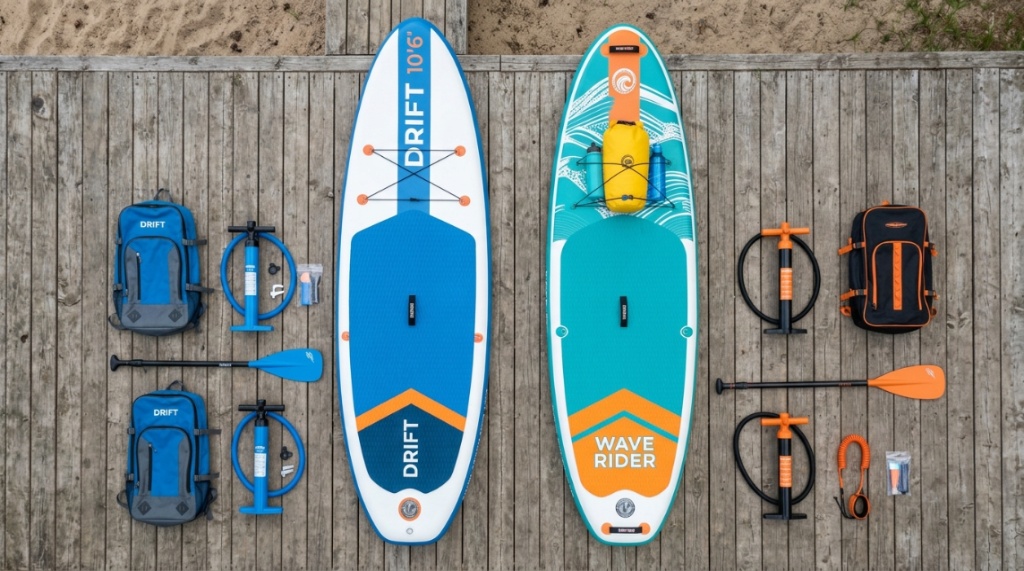
Most affordable boards include a paddle, pump, leash, and carry bag. But not all accessories are equal. Compare paddles—aluminum shafts are standard but heavy. A fiberglass or carbon-fiber shaft paddle costs more but reduces arm fatigue. Compare pumps too: dual-action pumps inflate twice as fast as single-action ones. A bad pump can turn a 10-minute inflation into a 30-minute workout.
How Do You Test Stability Without Actually Paddling?
Reading width and volume numbers correctly
Width is the single biggest predictor of stability. A board that is 34 inches wide will feel significantly more stable than a 30-inch board. Volume, measured in liters, tells you how much flotation the board provides. For beginners, look for at least 200 liters of volume. Heavier paddlers need closer to 300 liters to feel stable.
Understanding board shape for different water types
A full-nose shape (wide and rounded at the front) provides more stability on flat water. A pointed nose cuts through choppy water better but feels less stable. For Washington’s varied conditions—calm lakes, river inlets, and coastal bays—a semi-rounded nose offers a good middle ground. Compare shape profiles in product photos from the side and top.
Why customer reviews about stability matter most
Numbers only tell part of the story. Read reviews from people with similar body weight and experience level. Look for phrases like “felt solid underfoot” or “wobbled less than I expected.” Pay attention to reviews that mention the board’s performance in wind or small waves—these reveal real-world stability better than any spec sheet.
Is an Inflatable Board Better Than a Hard Board on a Budget?
Pros and cons of inflatable SUPs under $700
Inflatable boards dominate the affordable market for good reason. They are easier to transport, store in small apartments, and handle being bumped against rocks. The downside is that budget inflatables can feel less rigid than hard boards. However, modern drop-stitch technology has closed the gap significantly. For most paddlers, an inflatable under $700 offers better value than a comparable hard board.
When a hard board makes sense for your budget
Hard boards (epoxy or fiberglass) offer superior glide and speed, but entry-level hard boards often cost $600–$900. Budget hard boards under $500 are usually heavy, poorly shaped, and prone to dings. If you have a roof rack and dedicated storage, a used hard board from a reputable brand often beats a new cheap inflatable. But for most first-time buyers, inflatable is the smarter financial choice.
Storage and portability considerations
Do you live in an apartment or a house without a garage? Inflatable boards pack into a backpack-sized bag that fits in a closet. Hard boards require wall racks or ceiling storage. For Washington paddlers who want to explore multiple lakes and rivers, portability matters. An inflatable board lets you throw it in the trunk and drive to a new spot without hassle.
How to Compare Paddle Quality Without Breaking the Bank
Aluminum vs. fiberglass vs. carbon paddles
Aluminum paddles are heavy (around 32 ounces) and can fatigue your shoulders after an hour. Fiberglass paddles weigh around 20–24 ounces and flex slightly, which reduces joint strain. Carbon paddles are the lightest but often too expensive for budget bundles. A fiberglass paddle represents the best value upgrade for most beginners.
Adjustable paddle features to look for
Every budget paddle should be adjustable. Look for a push-button release system with clear markings for your height. A paddle that is too short forces you to bend over, while one too long causes inefficient strokes. Check that the adjustment mechanism feels secure when locked—cheap paddles can slip mid-paddle, which is frustrating.
When to upgrade your paddle separately
If the bundle includes a heavy aluminum paddle, plan to spend an extra $40–$80 on a fiberglass replacement. This single upgrade transforms your paddling experience more than any other accessory upgrade. Consider it a necessary cost, not an optional luxury. Your shoulders will thank you after a full day on the water.
Which Washington Water Conditions Affect Your Board Choice?
Lake paddling vs. river paddling differences
Washington has over 8,000 lakes, from calm Lake Union to windy Lake Washington. For lake paddling, a 10’6″ to 11′ board with moderate width works perfectly. River paddling requires a shorter board (9–10 feet) with more rocker (curved nose) to maneuver around obstacles. If you plan to do both, a 10’6″ board with moderate rocker is your best compromise.
Wind and chop considerations for coastal areas
Puget Sound and coastal areas like Westport can get choppy quickly. Wider boards catch more wind, making paddling harder. A board with a pointed nose and a length of at least 11 feet cuts through chop better. Consider adding a removable skeg (fin) for extra tracking in windy conditions. Budget boards often come with a single fin—two or three fins provide better stability in waves.
Seasonal weather patterns in Washington
Spring and fall bring unpredictable wind, while summer offers the calmest waters. If you paddle year-round, prioritize a board that handles wind well. Winter paddling requires a thicker board (6 inches minimum) for insulation from cold water through the deck. Summer paddlers can get away with thinner, lighter boards that are easier to carry.
What Pump Features Should You Compare Before Buying?
Single-action vs. dual-action pumps
A single-action pump pushes air only when you push down. A dual-action pump pushes air on both the push and pull strokes, cutting inflation time roughly in half. For a 15 PSI board, a dual-action pump saves you 5–10 minutes. This matters when you are eager to get on the water or when inflating multiple boards for family outings.
PSI ratings and inflation time
Most budget boards require 12–15 PSI. Higher PSI makes the board firmer and more rigid but requires more pumping. Compare the pump’s gauge accuracy—cheap gauges can be off by 2–3 PSI. A board inflated to 12 PSI feels noticeably softer than one at 15 PSI. If you prioritize rigidity, choose a board that supports 15 PSI and includes a pump that can reach it comfortably.
Electric pump options for budget buyers
Electric pumps cost $80–$150 and plug into your car’s 12V outlet. While not included in most budget bundles, an electric pump is a worthwhile investment if you paddle frequently. It inflates to 15 PSI automatically while you set up your gear. If your budget allows, factor this into your total cost comparison rather than relying on manual pumping every time.
How to Read Product Specs Like a Seasoned Paddler
Understanding drop-stitch and PVC layers
Drop-stitch refers to thousands of threads connecting the top and bottom of the board, giving it shape when inflated. More threads per square inch mean a stiffer board. Look for specifications that mention “drop-stitch density” or “thread count.” PVC layers protect the drop-stitch—double-layer PVC is heavier but significantly more puncture-resistant than single-layer.
Fin systems explained simply
The fin system affects tracking (how straight the board goes). US fin boxes are the industry standard and let you swap fins easily. Slide-in fins are simpler but harder to replace. Some budget boards have fixed fins that cannot be removed at all. For Washington waters with varying depths, removable fins allow you to adjust for shallow areas or different conditions.
Deck pad quality and traction
The deck pad is the foam surface you stand on. Full-coverage deck pads (covering most of the board’s top) provide more stability and comfort than partial pads. Look for diamond-grooved patterns that offer grip even when wet. A thin, cheap deck pad can peel off after a season. Read reviews specifically about pad adhesion—this is a common failure point on budget boards,Just as proper security camera placement is essential for protecting your property against theft, knowing how to properly store and lock up your gear ensures your budget watersports investment stays safe.
Can You Trust Budget Brands Available in Washington?
Reputable budget brands that deliver value
Some brands consistently deliver good value: iRocker, SereneLife, and Funwater offer boards in the $300–$600 range with solid construction. These brands have established customer service and replacement part availability. Avoid unknown brands with no US-based support. If you cannot find a phone number or physical address, proceed with caution.
Red flags in product listings
Watch for vague specs like “heavy-duty material” without specific details. Photos that show generic stock images rather than product shots are a warning sign. Reviews that say “great board” but lack specifics about stability or durability should raise suspicion. Cross-reference Amazon reviews with independent review sites to get a balanced view.
Where to buy budget boards in Washington
Local shops like REI and outdoor specialty stores carry curated budget options with the benefit of seeing the board in person. Online retailers offer wider selection but require careful spec comparison. Many Washington paddlers find success buying from brands that ship quickly from West Coast warehouses, reducing shipping time and potential damage. You can explore a curated list of trusted options at affordable stand up paddleboards Washington.
How to Test Your Board Before Taking It to Open Water
Inflation testing and leak checks
Inflate your board fully at home and let it sit for 24 hours. Check the pressure the next day—a loss of more than 2 PSI indicates a leak. Submerge the inflated board in a pool or bathtub to find bubbles. Most budget boards are airtight, but it is better to discover a defect during a backyard test than on the water.
Stability testing in shallow, calm water
Take your board to a calm, shallow lake or a swimming pool first. Practice getting on and off, kneeling, and standing up. This reveals any stability issues without the stress of deep water. Pay attention to how the board feels when you shift your weight side to side. A board that feels tippy in calm water will feel unstable in wind or chop.
Accessory function checks
Test the pump, paddle, and leash before your first real outing. Ensure the paddle locks at your preferred height. Check that the leash attaches securely to both the board and your ankle. A broken leash can leave you swimming after your board in currents. These checks take 15 minutes but prevent major frustrations later.
When Should You Spend More vs. Stick to a Strict Budget?
Signs that spending a little extra is worth it
If you weigh over 220 pounds, an extra $100 gets you a wider, higher-volume board that will feel dramatically more stable. If you paddle in windy areas frequently, spending $50 more for a better fin system improves tracking. If you plan to paddle more than 20 times per year, the per-use cost difference between a $400 and $600 board shrinks significantly.
When a strict budget board works perfectly
A $300–$400 board works well for occasional summer paddling on calm lakes, for children or lighter adults, and for families who want multiple boards without spending thousands. If you are unsure about your commitment to the sport, a budget board lets you test the waters without financial regret. You can always upgrade later.
Resale value considerations
Budget boards hold less resale value than premium brands. A $400 board may sell used for $150–$200. A $700 board from a respected brand may sell for $400–$500. If you think you might sell the board within a year or two, paying a bit more upfront for a recognizable brand often yields better return when you resell.
Frequently Asked Questions
How long do affordable inflatable paddleboards last?
With proper care, a well-made budget inflatable board lasts 3–5 years. Storage away from direct sunlight, rinsing after saltwater use, and maintaining proper inflation pressure extend the lifespan significantly.
Can I paddle in the ocean with a budget board?
Yes, but only in calm conditions with low waves. Budget boards lack the rigidity and fin systems needed for surf or strong currents. Stick to protected bays and calm ocean days for safe paddling.
How much PSI should I inflate my affordable paddleboard?
Most budget boards recommend 12–15 PSI. Check the sticker near the valve. Inflating to the maximum recommended PSI provides the best rigidity. Under-inflation makes the board feel unstable and sluggish.
Do I need a special paddle for an inflatable board?
No special paddle is required, but avoid paddles with sharp edges that could scratch the board’s surface. Most budget bundles include a paddle designed for inflatable boards with a nylon or plastic blade that will not damage the PVC.
What is the best budget paddleboard for a beginner in Washington?
A 10’6″ to 11′ inflatable board with 32–34 inch width, double-layer PVC, and at least 200 liters volume works best for beginners. Focus on stability and included accessories rather than brand names.
How important is the warranty on a budget board?
Very important. A 1-year warranty is standard, but 2-year warranties indicate better confidence in construction. Check warranty coverage for valves, seams, and accessories separately—some warranties exclude certain parts.
Can two people use an affordable paddleboard?
Only if the board’s weight capacity supports over 350 pounds combined weight. Even then, stability will be compromised. Budget boards are designed for single users. Tandem paddling is better left to wider, more expensive touring boards.
Conclusion
Comparing affordable stand up paddleboards comes down to knowing which specs actually matter for your weight, local waters, and paddling frequency. Width and volume determine stability far more than brand prestige. Accessory quality—especially the paddle and pump—affects your daily experience more than the board’s color or graphics. By focusing on drop-stitch construction, fin system compatibility, and real customer reviews from paddlers similar to you, you can find a board that delivers real value without breaking your budget. Washington offers incredible paddling from the San Juan Islands to Lake Chelan, and the right affordable board opens up all of it. Start your search by comparing the three factors that matter most: stability specs, included accessories, and construction quality. Your perfect board is out there waiting for you.