
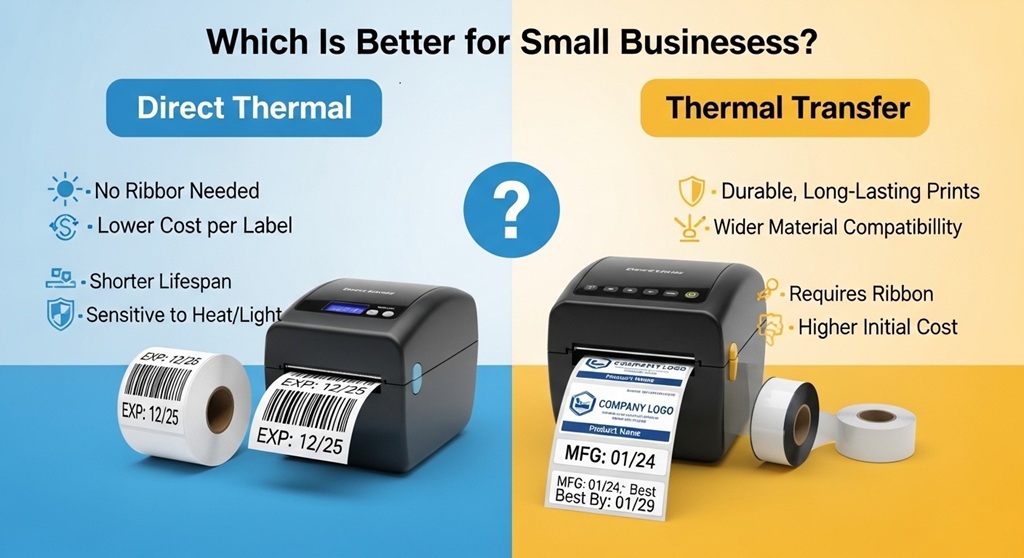
Direct thermal uses heat-sensitive paper and requires no ink, toner, or ribbon. Thermal transfer uses a heated ribbon to bond ink onto labels, creating more durable prints.
Choosing the right label printer can impact your operating costs, shipping accuracy, and customer satisfaction. Many small businesses struggle with one question: Should you invest in direct thermal or thermal transfer technology?
This printer comparison guide breaks it down in simple terms. We follow the PAS framework—Problem, Agitation, Solution—so you clearly understand what’s at stake and what works best in real-world scenarios.
If you run an eCommerce store, warehouse, retail shop, or small manufacturing unit, this guide will help you decide based on cost, label durability, lifespan, and workflow needs. No hype. No vague claims. Just facts, examples, and practical insights.
Why Does Printer Choice Matter for Small Businesses?
Printer choice affects operating costs, labeling errors, compliance, and long-term scalability.
Problem: Many small businesses buy the cheapest printer available without considering label lifespan or volume needs.
Agitation: Faded shipping labels lead to delivery failures. Damaged barcode labels disrupt inventory tracking. Reprinting labels wastes time and money.
According to logistics studies, barcode readability errors can increase warehouse processing time by up to 15%. That delay compounds quickly when handling hundreds of packages daily.
Solution: Understanding how each thermal technology works helps you align your purchase with your operational needs.
- Do you ship daily?
- Do labels need to last months or years?
- Are products exposed to heat, moisture, or chemicals?
The answers determine your best option.
How Does Direct Thermal Printing Work?
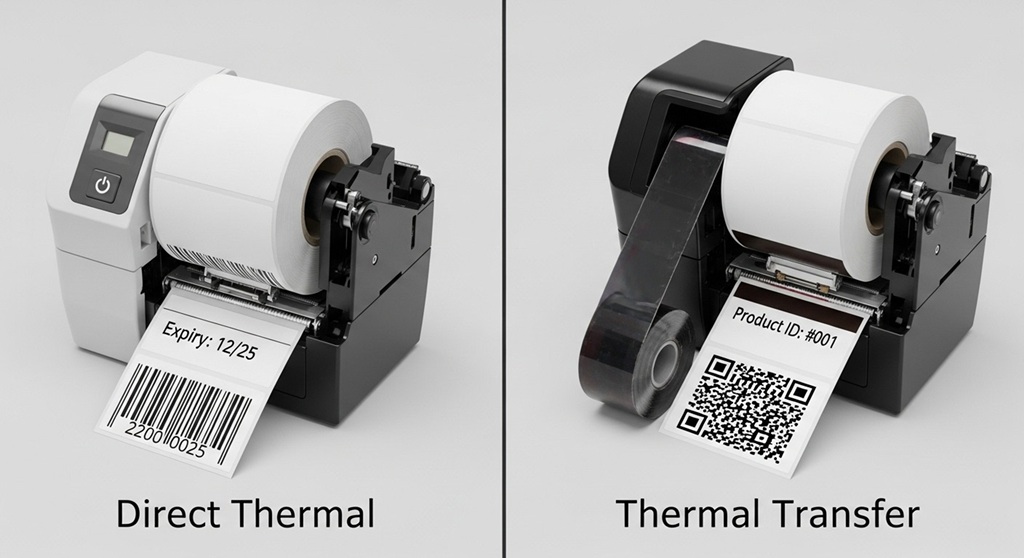
Direct thermal printers apply heat directly to chemically coated paper, which turns black where heated.
This process uses no ribbon. That’s why it’s often called inkless printing. The printhead creates images or text by activating the paper coating.
Key Features of Direct Thermal
- No ink, toner, or ribbon required
- Lower initial setup cost
- Fewer moving parts
- Best for short-term labeling
Where Direct Thermal Is Commonly Used
- Shipping labels
- Courier labels
- Retail receipts
- Temporary barcode labels
Limitations
Direct thermal labels fade over time. Exposure to heat, light, or friction accelerates fading. Typical lifespan ranges from 6 months to 1 year depending on storage conditions.
If your label must survive long-term storage, this may not be enough.
How Does Thermal Transfer Printing Work?
Thermal transfer printers use heat to melt ink from a ribbon onto label material, producing long-lasting prints.
The ribbon acts as an ink carrier. When heated, it bonds ink onto paper or synthetic materials.
Key Features of Thermal Transfer
- High label durability
- Resistant to moisture and chemicals
- Suitable for long-term storage
- Works with paper and synthetic labels
Ribbon Types
- Wax ribbons – economical, moderate durability
- Wax-resin ribbons – stronger resistance
- Resin ribbons – highest durability
Industrial sectors like manufacturing, pharmaceuticals, and food packaging often rely on thermal transfer for compliance labeling.
Which Option Is More Cost-Effective for Small Businesses?
Direct thermal has lower upfront and ongoing supply costs. Thermal transfer has higher supply costs but fewer replacement labels over time.
Cost Comparison Table
| Factor | Direct Thermal | Thermal Transfer |
|---|---|---|
| Initial Printer Cost | Lower | Higher |
| Supplies Needed | Special paper only | Labels + ribbon |
| Maintenance | Low | Moderate |
| Long-Term Label Replacement | Higher risk | Low |
Case Study Example:
A small eCommerce brand shipping 2,000 orders monthly used direct thermal printers. After 8 months, return rates increased due to barcode fading in high-heat storage. Switching to thermal transfer reduced relabeling costs by 12% annually.
Cost isn’t just about purchase price. It’s about lifecycle cost.
Which Printer Offers Better Label Durability?
Thermal transfer provides superior label durability compared to direct thermal.
If your labels must withstand:
- Sunlight exposure
- High temperatures
- Freezer storage
- Chemical contact
Thermal transfer is the better option.
Direct thermal labels can darken entirely if exposed to high heat. This makes them unsuitable for outdoor or industrial use.
For shipping-only businesses, fading usually isn’t a problem because packages reach customers quickly.
Is Inkless Printing Reliable for Growing Businesses?
Inkless printing is reliable for short-term labeling but may not scale for industrial needs.
Direct thermal printers are simple. Fewer components mean fewer breakdowns. For startups shipping under 100 packages per day, they perform efficiently.
However, scaling businesses often require:
- Long-term compliance labels
- Asset tracking labels
- Warehouse barcode durability
At scale, durability outweighs ribbon cost.
What Are the Maintenance Differences?
Direct thermal requires less maintenance but may need more frequent printhead replacement.
Since direct thermal printheads touch chemically coated paper directly, wear can occur faster.
Thermal transfer printheads last longer when paired with proper ribbon type. However, ribbon replacement adds operational steps.
Small businesses with limited staff may prefer the simplicity of direct thermal.
Which Is Better for Shipping Labels?
Direct thermal is typically better for shipping labels due to speed and lower cost.
Major courier systems rely on direct thermal for:
- Fast label production
- Short delivery windows
- Cost efficiency
Since packages are delivered within days, long-term fading is rarely an issue.
Which Is Better for Product Labels and Asset Tracking?
Thermal transfer is better for product labeling and asset tracking.
Industries requiring durable barcodes choose thermal transfer because labels must last months or years.
Examples include:
- Electronics serial labels
- Pharmaceutical packaging
- Warehouse inventory tags
- Manufacturing compliance labels
Durability reduces scanning failures and compliance risks.
How Do Environmental Conditions Affect Your Decision?
Heat, moisture, UV exposure, and friction strongly influence printer choice.
If your products are stored in:
- Hot warehouses
- Outdoor racks
- Cold storage facilities
Thermal transfer performs better under stress conditions.
Direct thermal works best in climate-controlled indoor environments.
Conclusion: Which Is Better for Small Businesses?
Direct thermal is ideal for low-cost, high-volume shipping. Thermal transfer is better for long-term durability and compliance needs.
Here’s the simplified takeaway:
- Shipping-focused business? Choose direct thermal.
- Manufacturing or asset tracking? Choose thermal transfer.
- Mixed operations? Consider having both.
Do not choose based only on printer price. Evaluate total cost of ownership, label lifespan, and operational scale.
Ready to upgrade your labeling system? Assess your monthly volume, environment, and durability requirements. Then invest with clarity. The right printer reduces errors, saves time, and supports growth.
Frequently Asked Questions
1. Do direct thermal printers require ink?
No. Direct thermal printers use heat-sensitive paper and require no ink or ribbon.
2. How long do direct thermal labels last?
Typically 6–12 months depending on exposure to heat and light.
3. Are thermal transfer labels waterproof?
Yes, when printed with resin or wax-resin ribbons on synthetic materials.
4. Which printer is cheaper long-term?
Direct thermal is cheaper for short-term labeling. Thermal transfer may reduce replacement costs for long-term applications.
5. Can I use both technologies in one business?
Yes. Many businesses use direct thermal for shipping and thermal transfer for durable labeling.
6. Is thermal transfer better for barcodes?
Yes, especially when barcode durability and long-term readability are required.
Don’t Miss These Articles: Top Budget Cordless Drills Under $50: DEKOPRO 8V on the List
Up Next: How to create a Scandi-style bedroom